The Quiet Giant: Why the Mainframe Revolution Is Happening Right Now
For years, technology forecasts have repeatedly announced the approaching end of the mainframe. Each new wave of distributed computing, public-cloud adoption, or serverless technology has renewed the prediction that traditional enterprise systems would soon become obsolete.
Yet mainframes continue to operate at the heart of the global digital economy. Everyday activities such as making card payments, booking travel, checking account balances, and processing insurance claims may rely on mainframe-based services. Many large banks, insurers, retailers, and public-sector organizations continue to depend on these platforms for high-volume, business-critical workloads.
The mainframe is not simply surviving; it is evolving. Its current transformation is being shaped by the growing need for real-time artificial intelligence, hybrid-cloud integration, stronger cyber resilience, and more accessible development tools. This is the modern Mainframe Revolution: a shift focused on making proven enterprise infrastructure more intelligent, connected, and adaptable.
1. On-Chip AI at Transaction Speed
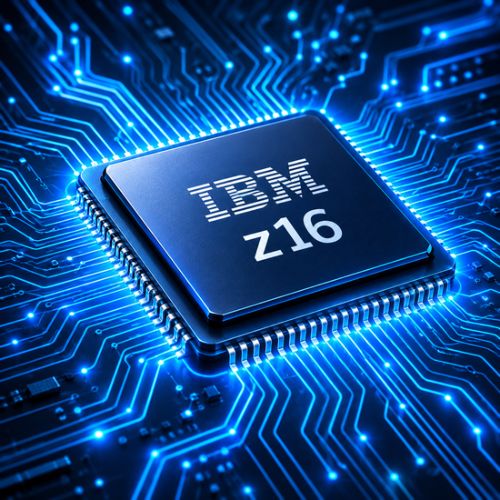
One of the most significant developments in modern mainframe computing is the integration of purpose-built AI acceleration into the processor architecture. IBM’s z16, powered by the Telum processor, brought on-chip AI inference to enterprise transaction processing. This enables selected AI models to analyse transaction data close to where the work is performed.
Consider payment fraud detection. In a conventional architecture, transaction information may need to be sent to a separate analytics environment for assessment, adding network delays and operational complexity. With appropriately designed on-chip inference, a mainframe can evaluate transactions within the transaction flow and return risk scores in near real time. This can help organizations identify suspicious activity quickly while maintaining the throughput and responsiveness expected of core banking and payment systems.
The broader benefit is the ability to bring analytics closer to mission-critical data. Organizations can make faster decisions, reduce unnecessary data movement, and apply AI to high-volume workloads without treating the mainframe as a separate or isolated platform.
2. From “Cloud-First” to “Hybrid by Design”
Enterprise modernization strategies have matured. The earlier approach of moving as many workloads as possible to public cloud environments has shown that a wholesale migration is not always the most practical option. Long-established transaction systems can contain decades of business rules, complex integrations, and demanding availability requirements. Moving them without careful assessment can introduce cost, risk, and performance challenges.
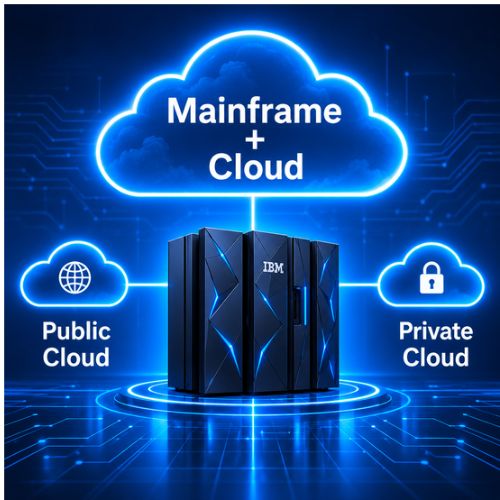
The more effective direction for many organizations is no longer Mainframe versus Cloud, but Mainframe working alongside Cloud. Each environment can be used for the workloads it is best suited to support.
APIs and microservices: Mainframe applications and data can be exposed through secure, standardized APIs. This allows web and mobile applications, digital channels, and cloud-based services to interact with trusted systems of record without having to duplicate core business logic.
Modern development toolchains: Mainframe teams increasingly work with familiar tools and practices, including Git-based source control, CI/CD pipelines, Visual Studio Code, and automated testing. Depending on the architecture and workload, Linux environments and container platforms can also complement traditional z/OS applications.
This hybrid-by-design model allows organizations to modernize user experiences and delivery practices while retaining proven mainframe capabilities for high-volume, transaction-intensive workloads.
3. Advanced Security and Cyber Resilience

As cyber threats evolve, the protection of sensitive information and the continuity of critical services have become central infrastructure priorities. Mainframe platforms have long emphasized security, isolation, reliability, and tightly controlled access. Modern systems build on these strengths with hardware-assisted cryptography, encryption capabilities, and security controls that can be applied across data and workloads.
Encryption can protect information both while it is stored and while it moves between systems. When designed and configured appropriately, hardware acceleration can help reduce the performance overhead associated with these protections. Mainframe security capabilities can also support stronger access governance, auditing, workload isolation, and operational resilience.
Quantum computing introduces another long-term consideration. The possibility that future, cryptographically relevant quantum computers could weaken some widely used public-key algorithms has accelerated the adoption of post-quantum cryptography standards. Organizations should assess their cryptographic dependencies, follow standards-based migration guidance, and plan for crypto-agile architectures. Mainframe environments can form an important part of this enterprise-wide strategy.
4. Closing the Skills Gap with Automation and Generative AI
The mainframe skills pipeline is an important consideration for organizations that operate long-lived COBOL, assembler, and transaction-processing applications. Experienced specialists hold valuable knowledge about business rules and operational practices, while enterprises must also make these environments accessible to the next generation of engineers.
Automation and generative AI are helping bridge this gap. AI-assisted tools can support code discovery, documentation, explanation of legacy logic, test generation, and refactoring analysis. They can help developers understand large codebases and evaluate modernization options, including selective integration with or migration to languages such as Java.
Modern development environments and automated delivery pipelines further reduce the learning curve. Engineers can apply familiar practices—version control, code review, automated builds, testing, and observability—while learning the platform-specific skills needed to support enterprise workloads. Human review, rigorous testing, and sound change governance remain essential, especially for mission-critical applications.
The mainframe survived the PC revolution, the internet boom, and the rise of the public cloud because it solves a specific problem better than anything else: processing colossal volumes of mission-critical transactions with near-100% uptime and ironclad security.
The mainframe revolution isn’t about replacing the cloud; it’s about completing it. By combining the agility of cloud-native development with the raw power, on-chip AI, and resilience of modern Big Iron, enterprises are building an infrastructure ready for the next fifty years of computing.